Traditional Therapy
TRADITION


Traditional Therapy

Tradition
We do not use the term Tradition in the sense of “historical continuity”, but rather it describes and refers to the core, to the essence of every authentic mythological-religious unity. Every authentic tradition is based on an archetypal conception of the cosmos, which is continually recreated through the rite and thus remains accessible to future generations. The manifestation of a tradition begins in the encounter, in the coming together of both worlds – the world known to us and the world beyond, unknown to us. In all traditions worldwide we find this legitimation of tradition through the encounter with the divine form. The myths of all cultures begin at this magical point.
Traditional therapy - Traditionale Therapie
“If the medicine of traditional civilizations knows nothing analogous to modern psychotherapy, it is because the psychological cannot be treated by the psychological. The psyché is essentially unstable and deceptive due to its specific nature, so that this can only be cured by resorting to something that is “outside” or “above”. “
Titus Burckhardt
According to the Greeks, an upright character and piety are qualities that a doctor or helper should possess. He should pay attention to the purity and simplicity of his garments and keep his body active through exercises. He should devote himself completely to his profession, which is why wealthy people were also encouraged to pay the doctor well so that he could also give his time to poor people. The doctor should have patience, be a good listener and take plenty of time for his patients. From Ebu Bekir Razi we read: “It would also be good to contact your doctor before you get sick. “
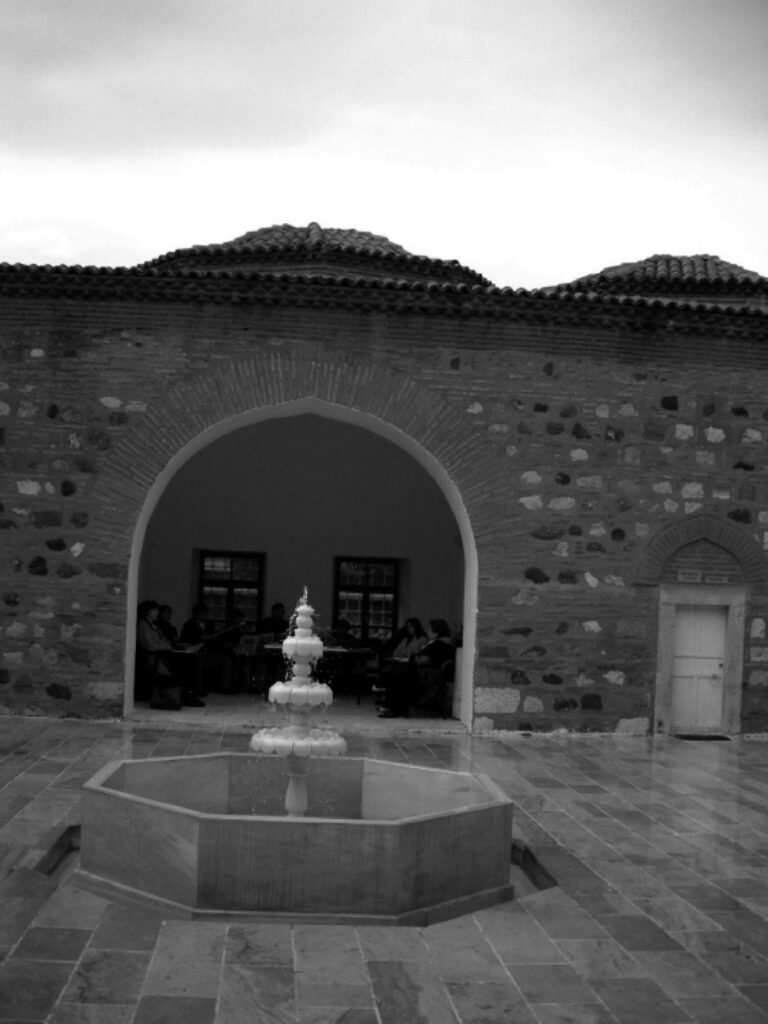
In the medical school in Kayseri (Turkey) it was common practice for the doctor to undergo not only a medical training but also equally an extensive spiritual training. The aspiring doctors also had to complete exercises such as withdrawn fasting (Halvet). The person who can help others must experience healing themselves and become “whole”. The idea behind this holistic approach is what Nizami points out to us: the need to develop intuition:
“A doctor should have a friendly disposition, a clear mind and he should have a developed intuitive power. Without the gift of intuition, a helper cannot recognize the real cause of an illness.”
Many traditional healers from different cultures were doctors, scholars and artists all in one person. Traditional therapy models have always been closely linked to human artistic expression (be it design, painting, singing, music or dance). We can go so far as to claim that art and therapy can be found together in traditional societies worldwide. In the myths we find this close connection between “art” and “healing” right from the beginning of human existence, as a legend by the Persian poet Hafiz (14 hdt.). He tells us:
“God created in his own image a figure of clay and water and asked the soul to enter this body. However, the soul refused to be captured, because by its nature it is free and did not want to be restricted and bound to anything. So the soul did not feel the slightest inclination to enter this earthly prison. Then God asked the angels to let their music sound, and when the angels played, the soul fell into ecstasy because of this ecstasy and because it wanted to experience the music even more intensely she entered the body.”
The primordial Tradition - die ursprüngliche Tradition
Ananda Coomaraswamy writes: “The ‘philosophy perennis’ – ‘the eternal philosophy’ is the original and universal tradition present in all authentic civilizations.”
If this is true, then in all authentic traditions we should find similar principles and fundamental pillars on which each tradition is based. The stories, the images, the mythologies form the skeleton of a tradition and in comparing them in different cultures, one should discover similar legends and myths. If this can be proven, then one would be dealing with universal principles that have taken on individual manifestations through respective historical or local metamorphoses. In this sense, there is only one original (primordial) tradition, which has become visible on our planet with many different faces. All tradition-bound disciplines such as art, ritual, healing, therapy, etc. would also follow this principle and point to an underlying universal structure.