Traditional oriental Musictherapy
TRADITION
Traditional Oriental
Musictherapy
As a teenager, I had a dream where I heard special music in the distance. I followed this music and finally I reached it: I saw people dancing and making music and playing this special music, which later became the basis of my own music.
Oruç Güvenç
In the 70 ´s of the last century, Dr. Oruç Güvenç started to research the system of oriental music therapy historically and began testing it in practice. In his dissertation in 1985 he presented an investigation into music therapy in hospitals all over the oriental world. Dr. Güvenç founded the “Center for Research and Application of Turkish Music” at Cerrahpaşa University and began to establish oriental music therapy in the East and West.
Oriental Music therapy has a thousand-year history and was founded by Dr. Rahmi Oruç Güvenç. He brought the system of Oriental Musictherapy to new life on the basis of traditional knowledge, historical sources and the ability of intuitive knowledge. Today it is an established system that has gained recognition throughout Europe and the oriental community.
Oriental music therapy is primarily divided into an active and passive form of Music-therapy.
Active music therapy is a multi-part movement set that is accompanied by pentatonic music from Central Asia. The movements of the set have their roots in the dervish and shaman dances of Central Asia.
Passive music therapy has been used primarily in hospitals in the Orient since the 9th century. It is based on the oriental sound system (Makam system), which was attributed by the Islamic doctors of the Middle Ages to have an emotional and physical (organ-specific) spectrum of effects.
Men & Music
Music and the need for artistic expression were of similar importance to the Homo sapiens as food, sleep and reproduction. Artistic expression was so essential for the preservation and development of humans (the development of the brain, the development of language, the development of communication and social cohesion) that the beginnings of artistic design are equated with the appearance of modern humans.
G. Ilyas Klawatsch
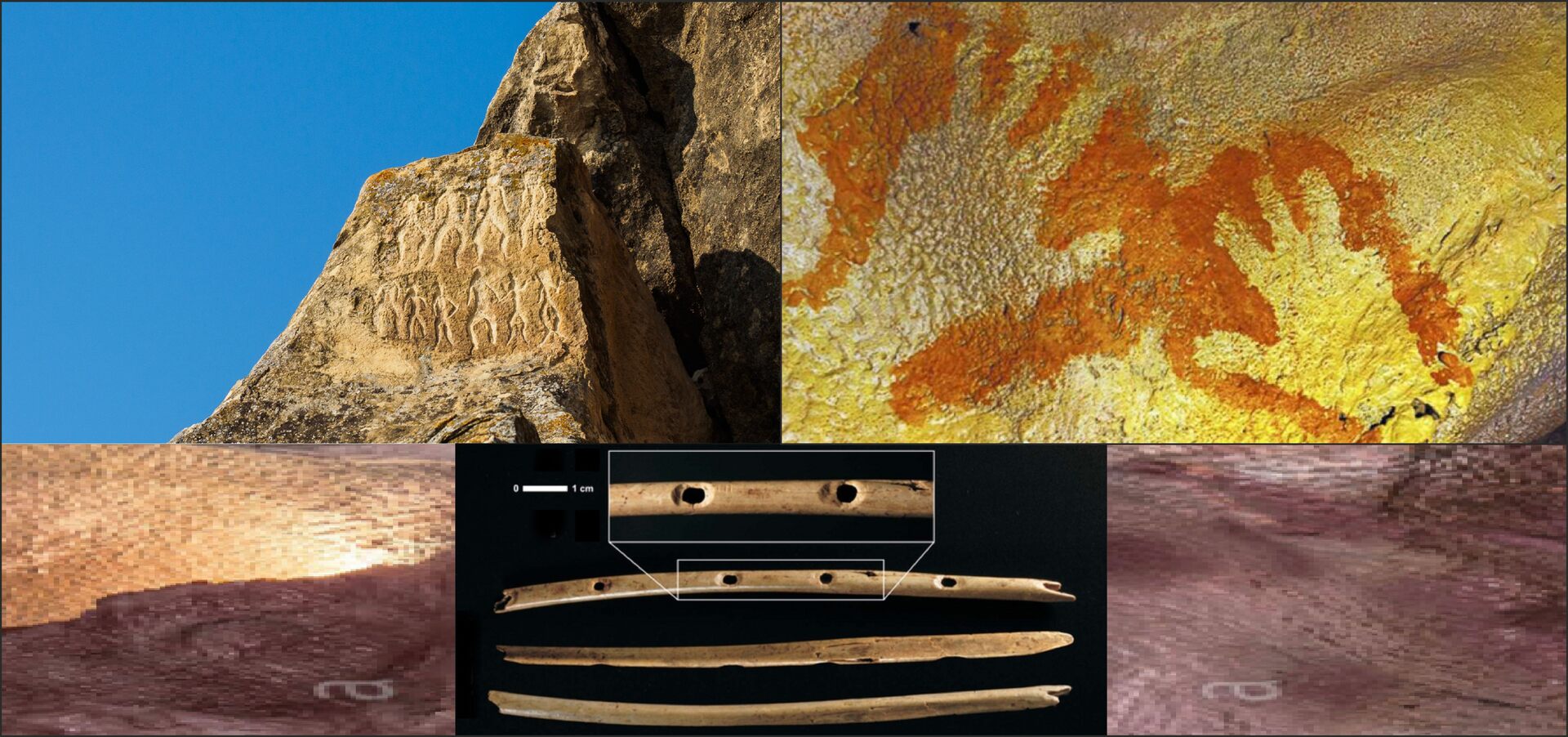
We find the artistic expressions of dance and music and their connection to healing traditions in all cultures worldwide. So we find signs that artistic expression in general and in particular through the phenomenon of music is a fundamental need of being human and is connected to the human being from the beginning. In many myths and creation myths from different peoples and cultures we often find a connection to sound and rhythm. The oldest musical instrument found to date are flutes, which were found in the Swabian Alb in southern Germany and have been dated to 40,000 years ago. These instruments are attributed to the first hominids of the Ice Age. Amazingly, symbolic cave paintings were found in Spain, which were even dated to 65,000 years ago, showing that symbolic art had been practiced by Neanderthals 20,000 years before Homo sapiens appeared in Europe. Homo sapiens is at least 300,000 years old, and during this time their appearance has changed only slightly. The anatomical predispositions for singing, for example, were probably already present back then. Singing, dancing and simple musical instruments (such as the drum) were probably known to Homo Sapiens for far longer than 70,000 years.
Gobustan in Azerbaijan is one of the oldest residences of humanity. The place essentially consists of a hill and a mountainous area in the southeast of the Caucasus. There are 6,000 rock engravings to be found, the earliest of which were carved into the rock around 12,000 years ago. You can also find caves there that were one of the first human settlements in world history. The cave walls are covered with images of various actions such as hunting, people dancing and other aspects of daily life and are at least 5000 years old.
Model of Therapy
A 14th century description by Abd El Kerim Al Khahal summarizes what music can do as a form of treatment:
Music has both dietary and therapeutic functions. As an implementation of the “cosmic sound”, it nourishes the human spirit soul in the same way that material food nourishes the body.
The Sufi Master Turgut Baba tells us: “Everything is a form of oscillation or vibration.” From physics we know that everything (colors, sounds, etc…) has a vibration – a frequency. Musical expression is a form of this vibration. If music is practiced with the idea of harmony in melody and rhythm, then it has the potential to be used for healing and therapy. The beauty in music, the harmony is a manifestation of an “ultimate reality”. This form of music is a gift to people. In this concept, music is an image of the sound of the primal contract between man and the Absolute.
This beautiful sound reminds people of their origins and touches them deeply. There is an aspect of the “eternal” and the “perfect” in this beautiful sound. This makes it possible to use music as a remedy and therapy for people and to influence people’s physical, emotional and spiritual balance.
Illness – Drop out of unity
In the traditional view, illness is the phenomenon when a person falls out of unity. Friedrich Weinreb writes: “Man does not live in a physical or a mental reality, but in both. And if you don’t take one into account or if you act as if there was only one, you break the person. Then you produce the „modern man“, who feels sick, who feels unhappy and who feels restless.”
Weinreb continues: ” Illness is only frightening when you leave it alone and septerate it from the divine” “
The loss of unity and the longing for it is a mythological theme that can be found in traditional societies worldwide, beyond culture and religion. The underlying model of oriental music therapy is based on a healthy and indestructible core (seed) in the human structure. Illness occurs when there is a loss of basic harmony in a person’s life. The disharmony that has become manifest in the body can be returned to its original balanced state through harmonizing impulses. Avicenna (Ibn Sina) advocates that mind, as a metaphysical principle, governs matter. The human body is a materialized image of the human soul. By strengthening the soul, the physical nature can also be strengthened.
In the dolden age time of Islamic sciences, the fundamental maxims for this holistic therapy system were created and formulated. Al Farabi (870-950 AD) writes: “The body is sick when the soul is weakened and it is impaired when it is weakened. Therefore, the healing of the body takes place through the healing of the soul by restoring its powers and bringing its substance into the right order with the help of sounds that can achieve this and are suitable for this.”
So in that way, through the therapeutic process their is establisehd a contact to the “healthy” structure in people, and this releases an impulse towards harmony and recovery. It is possible to change a person’s emotions with certain music and this forms the basis for a reorganization of the entire structure. Prophet Mohammed says in a Hadith: “The exact exists in the middle, in the balance and not in the extremes.”
.) Music is particularly suitable for mental hygiene and healing
.) Music has a direct organ-specific effect. It affects the body via the Nefs (soul).
.) Music has a healing effect through the joy it can evoke in people.
.) Music has a strengthening effect on the immune system
.) Music is used to treat acute pain
History
Oriental music therapy has its roots in Central Asian shamanism, in the cultural golden age of Islam (8th-14th centuries) and in the religious movement of Tasavvuf.
Central Asian Shamanism
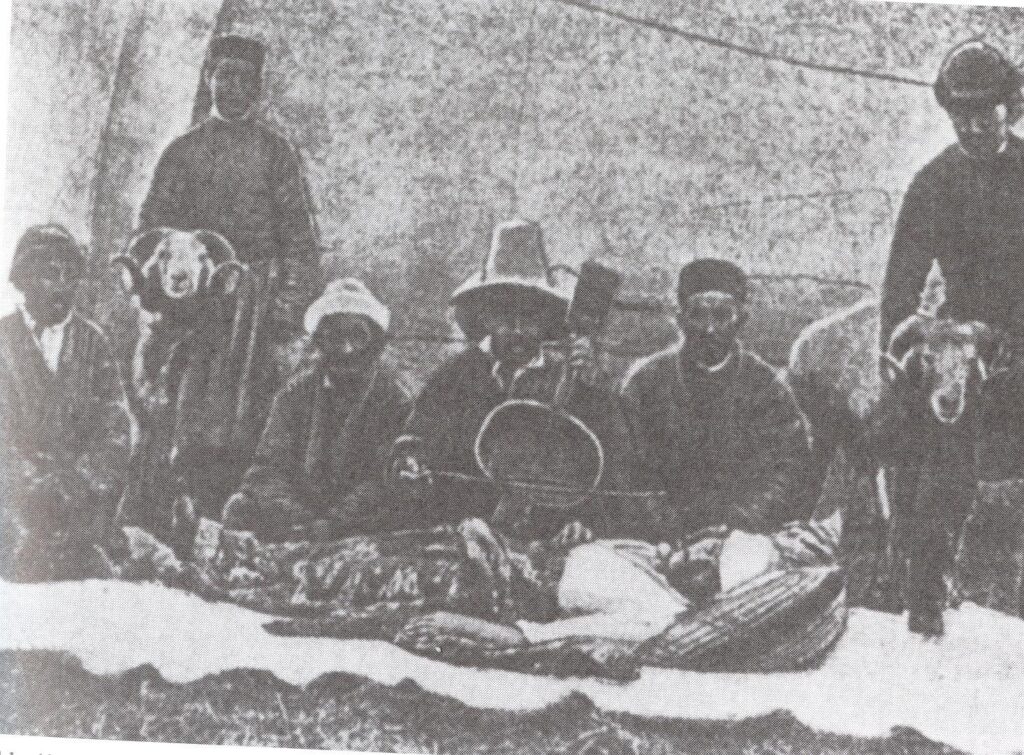
The shamanistic tradition of Central Asia and the pentatonic folk music of the Central Asian Turkic peoples have an important place in oriental music therapy. Even before the spread of major religions such as Buddhism, Manichaeism and Islam, the Turkic peoples of Central Asia had a spiritual tradition that combined music, dance and healing (therapy). This original form of healing combined with artistic expression is a worldwide, universal phenomenon and can be found in almost all indigenous groups.
The worldview of the Central Asian Turkic peoples was characterized by nomadism and a shamanic culture. The shaman draws his spiritual power and information from the living stream (Ata Ruhu) for the benefit of the entire clan. Their goal was and is to live in harmony with this infinite stream. In the culture of the Kazakhs and Kyrgyz, the shaman was called Bakse or Kam. The Bakse usually only receives the gift of singing and making music during initiation to become a shaman. Playing instruments, singing and the melodies of songs come spontaneously as knowledge to these chosen people. In the trance, which the Bakse achieves only with music and dance, he becomes able to help the sick person by receiving information about the cause and the treatment of the illness. When shamans enter a trance they imitate the movements of animals and movements from nature. Swans, horses, bears and birds are imitated and in the ongoing trance, spontenious movements arise that emerge uncontrollably from the Bakse. The main instruments of this culture are the dombra and the kilkopuz. As Islam spread and came to Central Asia, there was often mixing between the Bakse tradition and the Islamic tradition of Sufism. The successors of the Bakse shamans in the Islamic period were the Hakims.
The movements oft he Bakse dance, the shamanic instruments Dombra and Kilkopuz, as well as the pentatonic music of the Turkic peoples of Central Asia were included in the structure of ‘Oriental music therapy’.
Golden age of Islamic science and religion (8. – 14. Jhdt.)
In the golden age of Islam in the 12th century the borders of the empire stretched from Samarkand to Damascus, from Cairo to Fes and Cordoba; More and more people became Muslims, and more and more cultures found their way into Islam. In a historical overview, we can now see that the Islamic Empire represented a bridge between ancient Greek culture and the Renaissance. At a time when the Western world was sinking into barbarism, the Islamic world reached its peak. The most important legacy from this period are the translations from Greek into Arabic and later into Latin at the end of Islamic rule. The majority of Greek writings would not have survived and never reached the Western world if it had not been for this bridge. The main character here is a caliph from Baghdad, Almamun (9th century). Almamun founded the “House of Wisdom” based on a dream. This house was perhaps one of the few truly multicultural houses that had ever existed in history. The special thing was that wisdom and politics pulled together and so it was possible to implement such a huge project. Hundreds of translators from all parts of the empire – Jews, Christians, Persians, Arabs, etc. were mobilized and the entire Greek heritage (writings of philosophy, medicine, astronomy from Plato to Galen) were translated. In addition, writings from Sanskrit and Persian were also translated. The House of Wisdom was a special association and provided an extraordinary service to humanity and was able to be maintained for three centuries despite fundamentalist countercurrents. Here, where the history of Islamic science and philosophy begins, the history of the oriental use of music as an auxiliary discipline of medicine also begins. Well-known names in this context were Al Kindi, Al Farabi, Al Razi, Averroes, Ibn Tufail and Ibn Sina (Avicenna). Many of these scholars were polymaths, trained in philosophy, astronomy, astrology, mathematics, music, and medicine. They absorbed the insights and writings of the Greek scholars, integrated them and then continued them with their own thoughts and beliefs. It was an attempt to harmonize and reconcile philosophical and religious knowledge.
Music Therapy in oriental hospitals
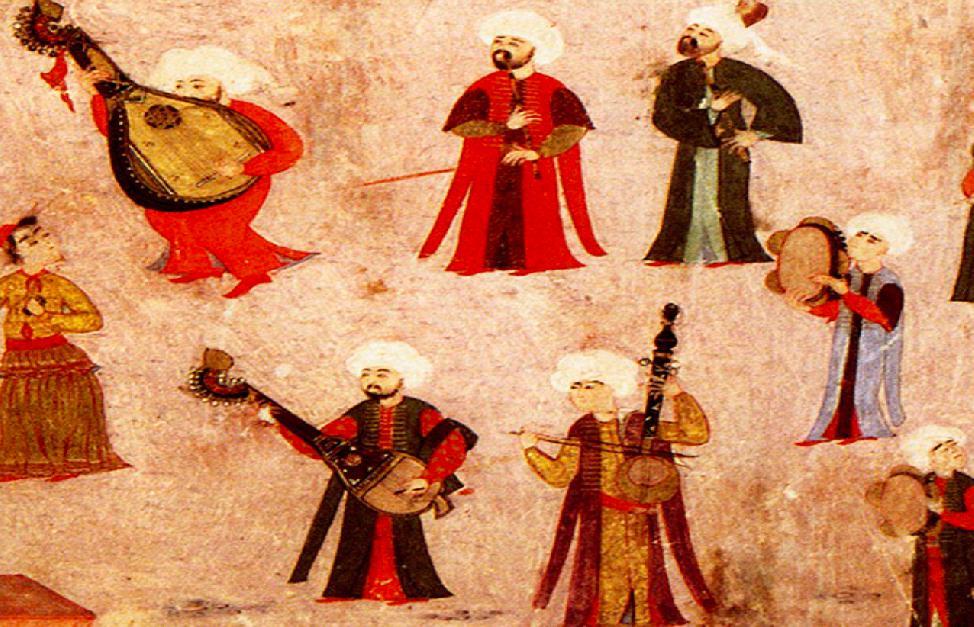
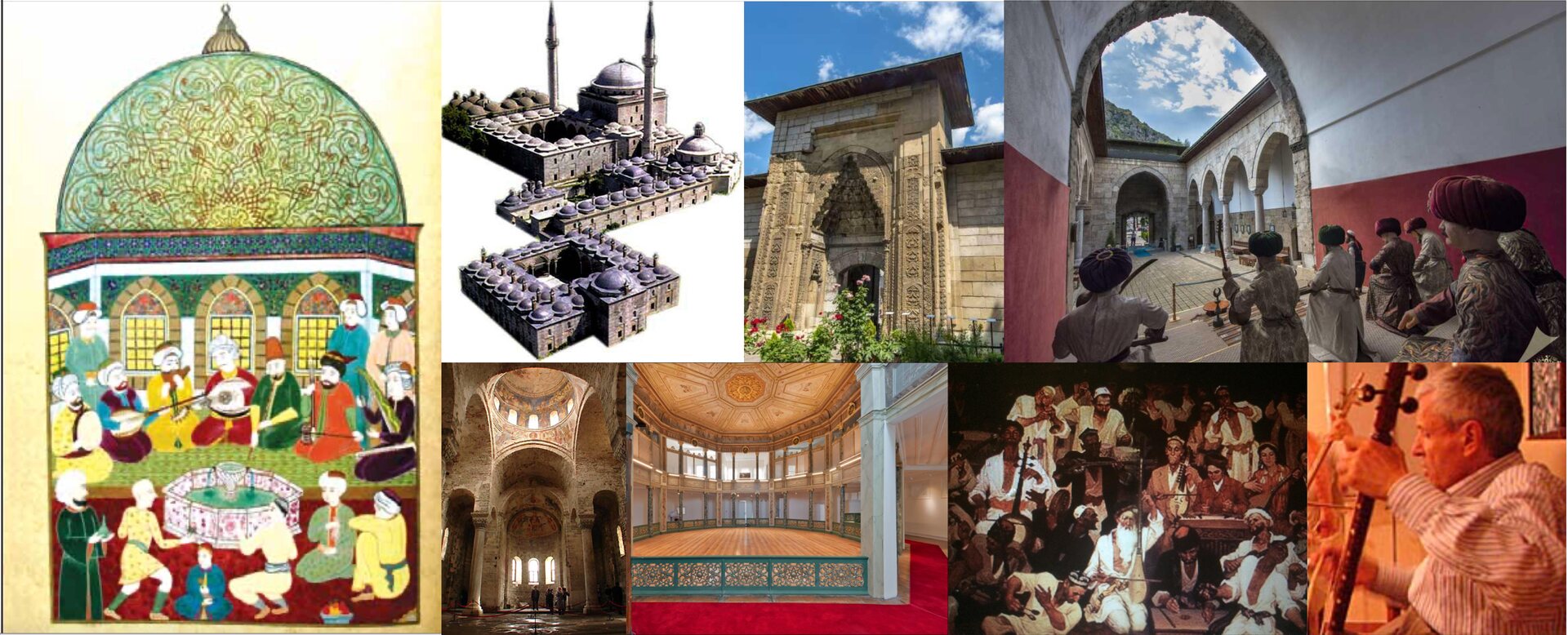
Music Therapy was an auxiliary discipline of medicine and was used in hospitals and psychiatric clinics. From the 9th/10th century onwards, music-making fort he sick can be found throughout the Central Asian-Turkish region. The idea of the hospital grew out of the religious commandment of caring for those in need in the Christian-Islamic world. In the beginning there was usually the charitable foundation (Vakif) so that the hospitals could be financed and maintained on a donation basis. And in this way, free treatment for patients was usually ensured. These hospitals were often entire building complexes, like small village units. Such a building complex included a mosque, a madrasah (Koranic school), a caravanserai for travelers, a soup kitchen, a hospital, a widows’ and orphans’ home and a hankar (monastery). In these hospitals, patients also received therapy with music. There were music therapy hospitals in Damascus, Sivas, Kayseri, Bursa and Edirne. The Turkish traveler Evliye Celebi (1614-1682), who visited the hospital in Edirne, gives us an eyewitness account from this time: “Poor and rich, young and old, lie in this hospital with a wide variety of illnesses. Depending on the illness, patients are given a diet and the rooms are heated in winter. His Majesty the Sultan Bayezid has determined in a foundation deed that 10 musicians will be employed to play music for the clients three times a week: three singers, a Neyzen (reed flute), a fiddle player (Kemani), a pan flute player, a dulcimer player (Santur), a harpist (Cengi) and a lutenist (Oud). According to the will of the Almighty, a considerable number of them find solace through the sounds. If the mode of Zengüle and Buselik are played and concluded with the mode Rast, it is as if they bring a new life. There is food for the soul in all instruments and macams.”
In the inner courtyard of the hospital in Edirne there was a fountain that supported the healing effects of the music with its gentle babbling of water. In addition to the doctors and musicians, there were storytellers for the patients. Çelebi further writes that the therapy was supported with wonderfully fragrant and beautiful flowers: “Especially in spring, they give the patients beautifully scented flowers such as jasmine, carnations, tulips, roses and, accompanied by appropriate music, heal the patients.”
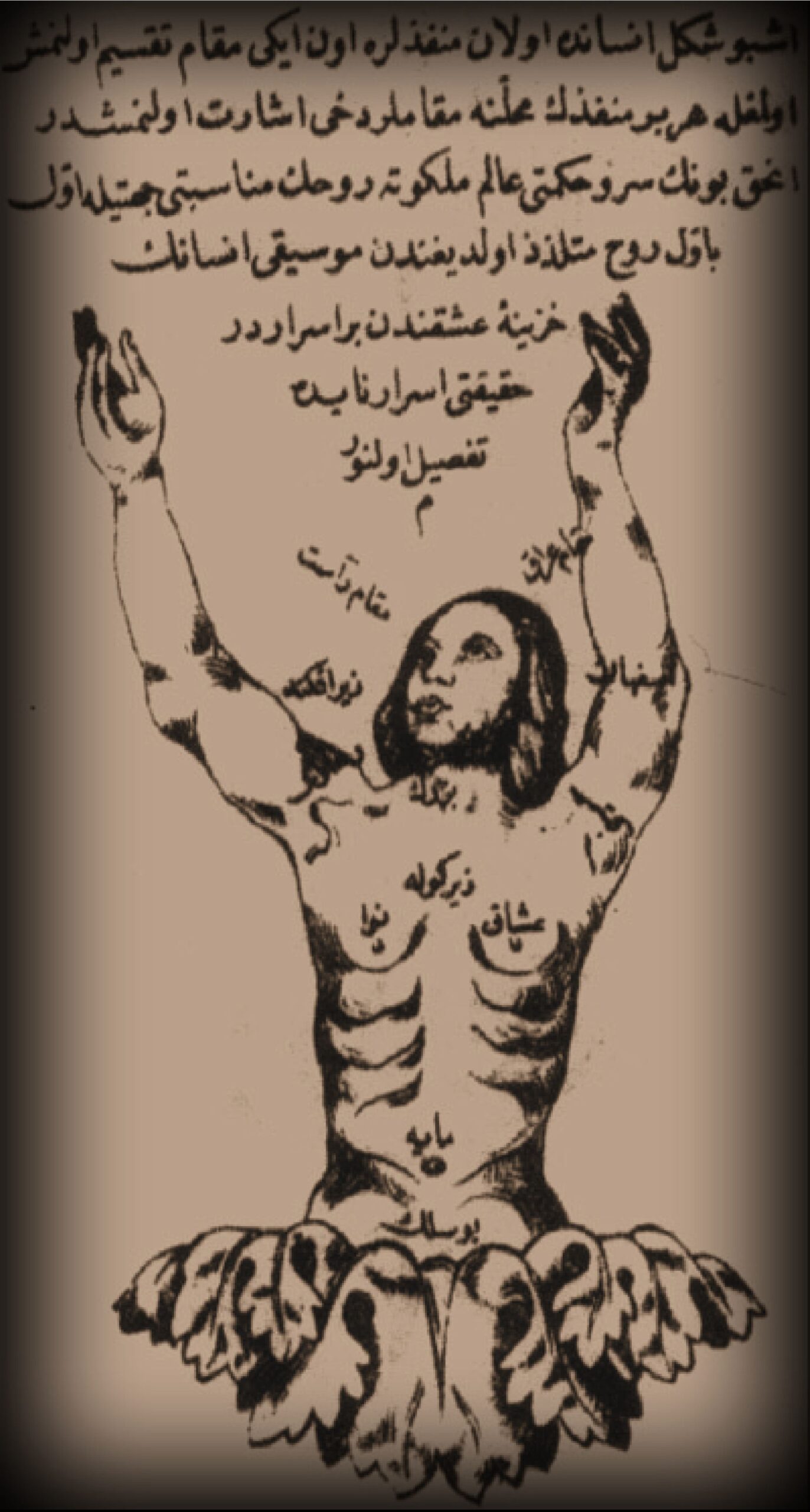
Based on the previous pulse diagnosis, the appropriate makamen (tones) were selected, which in most cases relieved the pain. The oriental key system (the Makam system) formed the basis for this form of music therapy. The Makam system is a microtonal system that produces around 400 different modes, although only a fraction of them have been used in therapy and have found their way into the literature. Makams have associations with times of day, zodiac signs, days of the week, body regions, organ-specific associations and emotional states. The Islamic philosopher Al-Farabi (*870-950) summarized some makams and their effects on people in his work “Musikiul-kebir” as follows: “The Rast makam pleases people and gives them satisfaction, the İsfahan Makam gives people mobility and self-confidence. Segah calms and promotes sleep – the Neva-Makam gives appetite and calmness. The Uşşak Makam (one of the oldest makam) makes people laugh and deeply delight the soul. Zengüle promotes sleep. Saba-Makamı gives strength, and the Hüseyni-Makamı gives man contentment, well-being and perfection.”
The Makam system, its physical and emotional associations, its astrological and temporal associations were studied, summarized and incorporated into traditional oriental music therapy as passive music therapy – and have been practically verified for over 30 years. The idea of flowing water in the hospitals of the Orient was adapted and incorporated into Oriental music therapy. Also the holistic human & world view was transfered to he modern form of Oriental Music Therapy.
Tradition of Tasavvuf
Tasavvuf (Islamic Sufism) is founded in the beginnings of the Prophet Mohammed and can be described as the inner knowledge (hikmet), the mysticism of Islam. In many tarikats (religious communities) artistic expression, music and dance play an important role. In the mystical ceremonies of the whirling dervishes, music is the symbol of the divine voice that moves the souls to live and dance. This is how life itself becomes music and dance. The religious songs (Ilahis) that accompany the dervishes’ ritual prayers and gatherings have given rise to their own musical genre. But arts such as calligraphy, tezhip (ornamentation), ebru (marbling) and architecture (e.g. the Ottoman architecture of the Bektashi shrines) are also deeply anchored in the Tasavvuf culture.

The great mystic Ibn Arabi writes “Love is the movement of beauty.” Artistic expression is the method of making the incomprehensible reachable – bringing infinity into finiteness. Man himself is a work of art, who realizes his own nature by imitating the creative forces. There is a hadith in which Prophet Muhammad says “God is beautiful and loves beauty”. Art has the potential to manifest divine truth. Dance, music, and artistic expression provide a method of spiritual growth. The religious Ilahi music, the Mevlevi instruments Ney and Rebab, the definition of man as a bridge between heaven and earth and the deep knowledge of the Islamic Tasavvuf have found their way into the therapeutic model of traditional Oriental Music Therapy.