Bengüsu- gield
bengüsu
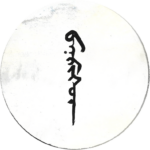
Our logo refers to the old Turkish word BENGÜSU, written in old Uyghur script.
bengüsu (Old Turk.) – has the root word bengi, bengü, mengü and is translated as ‘eternal’ or ‘immortal’.
su (Turkish) – is the Turkish word for water.
Translation: Water (source) of eternal life, water of immortality
Old Uyghur calligraphy: The Uyghur alphabet is an alphabet that comes from Aramaic via the Sogdian alphabet and was used to write the Old Uyghur Turkic language. The earliest characters of this script can be found in the 5th century. A.D. . The Old Uyghur alphabet was later replaced by the Arabic alphabet and the Uyghur characters survived only in the Mongolian script (from the time of Genghis Khan), which used the Old Uyghur alphabet as the basis for their own script.
Meaning: One of the first abstract concepts that the human mind perceives, because he is faced with the fear caused by death, is the concept of eternity, or infinity. The resurrection after death and the search for eternal life can therefore be found in many myths and stories. In many civilizations there is a belief in a water that gives eternal life or long life. Those who bath in or drink from this water attain immortality and youth. It often arises from the root of the Tree of Life (Uluğ Kayın) and is then usually described as a spring, stream, river, pond or lake. This special water brings the dead to life, satisfies the desire of the longing heart, gives wisdom and knowledge, heals the sick and gives youth, strength and immortality to those who drink it. We find this source of life, it is said, in a dark, unknown world called „Zulmet“.
The great mystic Ibn Arabi says: “Eternity is a negative attribute. Eternity is the negation of a beginning and an end and also negates the definition of endless extension. Allah created the world outside of time.”
We find the story of the water of life BENGÜSU in folk epics such as the Köroğlu epic and in the tradition of Tasavvuf (Hızır and İskender Zulkarneyn), further reaching back to the first civilization in Sumer in the Gilgamesh epic and in similar myths of the ‘immortal water’ or an ‘elixir of immortality’ worldwide.
gield
gield (Old English), guild (German): The original meaning of the word ‘guild’ is of pagan origin and means ‘sacrifice’, ‘donation’, ‘brotherhood’. We also find the meaning of ‘sacrifice’ in the Arabic and Hebrew word ‘kurban’, which also means sacrifice and symbolizes the “approach to the one truth”. Furthermore, in the word guild we find the meanings of ‘celebration’ and ‘banquet’ and then also the religious meaning of ‘brotherhood’, ‘community’ and ‘protective association’.
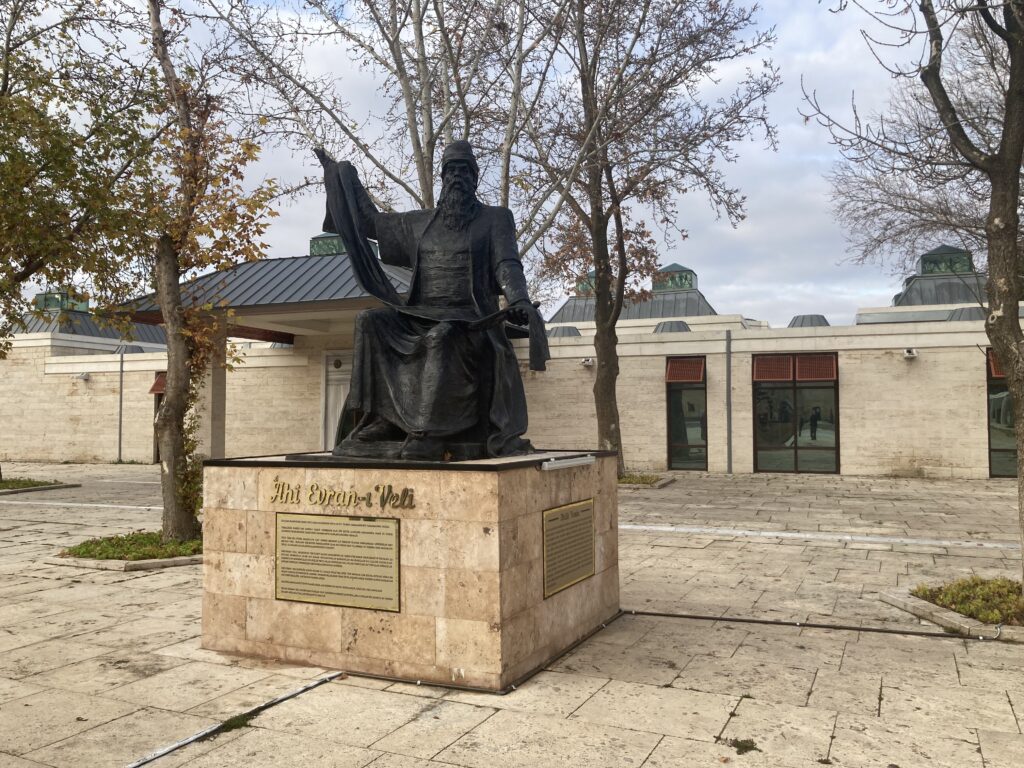
Pir Ahi Evren-ı Veli
Ahi Evran (1169–1261), born in Khoy (present-day Persia), was a Turkish Alevi Sufi saint, philosopher, poet, and founder of the Ahi Guild, a brotherhood and craft guild. He grew up in Azerbaijan and then moved to Kayseri in Turkey, where he worked as a leather merchant and where he began organizing the urban Muslim artisans. This oriental guild system, which dates back to Ahi Evran, was not based on the Roman model of the craft guilds in the Byzantine Empire.
The guild members called themselves Ahis and the organization spread extensively throughout the Orient. The Ahi brotherhood was formed at about the same time as the large Sufi communities of the Mevlevis in Konya or the Bektashis in Anatolia. The Ahis had very similar ideals to the Sufi brotherhoods – such as: moral and ethical principles in dealing with one another, offering products of the highest quality, serving people, humanistic and social commitment, supporting and caring for the poor and travelers. In the Ahi Guilds there were also initiation and rites of passage related to knowledge and skill. These ceremonies had a strong religious content. Ahi Evran then moved on to Konya and died in Kirsehir in 1261. (Türkiye)
The oriental guild system functioned for many centuries until it collapsed at the beginning of the 20th century. completely and disappeared.
Story of the community bengüsu gield
The community ‘bengüsu gield’ emerged in 2017 from the ‘Centre for Ethnotherapy’ (founded in 2008). With the blessing of Dr. Güvenç the center was dedicated to passing on traditional forms of therapy and researching religious, artistic and medical-therapeutic connections. The institute networked internationally and was able to attract some important personalities for lecture series. (Hossein Nasr, Eduardo Duran, Chong An Sunim, etc…) The “Center for Ethnotherapy” provided the idea and the basic framework for the university course “Transcultural Counseling & Migration” run by Arge B. in a corporation with the Siegmund Freud Private University.
The ‘bengüsu gield’ community is increasingly dedicated to spreading and passing on the legacy of Dr. Oruç Güvenç; research into traditional forms of art and therapy, and support establishing The Tradition of Tasavvuf (Sufism)- in practice and study – in the western culture.